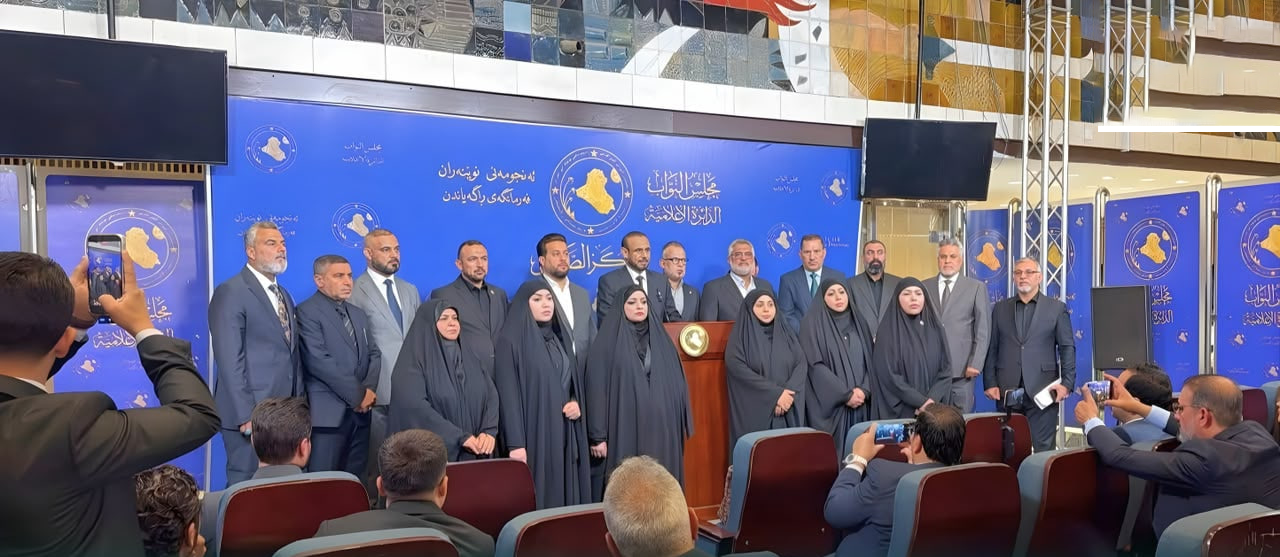
Al-Sadiqoon MPs support Sheikh Al-Khazali’s vision: Iraq’s sovereignty, state institutions, and dialogue are the priorities of this phase.

On Friday, MPs from the Al-Sadiqoon parliamentary affirmed their support for the views expressed by the General Secretary of the Asa'ib Ahl al-Haq, His Eminence Sheikh Qais al-Khazali, during his televised interview yesterday. They emphasized the importance of the insights and positions he articulated regarding sovereign, security, political, and economic issues, as well as the necessity of consolidating independent Iraqi decision-making, strengthening state institutions, and adhering to the constitution and the law.
The head of the Al-Sadiqoon, Uday Awad, stated that Sheikh al-Khazali’s remarks presented a clear vision for addressing several sensitive sovereign issues a vision centered on a strong state, full sovereignty, official security institutions, and a national approach to Iraqi affairs free from external dictates. He affirmed that the parliamentary responsibility lies in supporting the state and its constitutional institutions and in solidifying Iraq's independent national decision-making.
For his part, Habib Al-Halawi affirmed that the remarks made by His Eminence Sheikh Qais Al-Khazali clearly addressed sensitive issues—foremost among them state sovereignty, the regulation of arms, the institutionalization of the Popular Mobilization Forces (PMF), respect for the Constitution, and the independence of Iraqi decision-making noting that these matters warrant discussion based on the logic of statehood and the national interest.
Similarly, Ahmed Ali Al-Asadi expressed his support for Sheikh Al-Khazali’s assertion that Iraq’s sovereignty is incomplete without the strength of its institutions and their capacity to manage security affairs in accordance with the Constitution and the law, free from external interference. He emphasized that this constitutes the core of the national project to build a strong state capable of safeguarding its sovereignty through its laws, army, PMF, and constitutional institutions.
In the same vein, Riyadh Al-Tamimi observed that the points raised by Sheikh Al-Khazali in his televised address encapsulate Iraq’s current needs: a strong state, a robust economy, and independent political decision-making where Iraq’s name, reputation, and national interest take precedence over personal and partisan interests.
Al-Tamimi explained that a strong Iraq does not imply isolation; rather, it means possessing the ability to make decisions in the people's interest and to build balanced relationships that safeguard the nation's sovereignty and stature. He noted that politics alone cannot build a strong state; strength requires a robust economy, the genuine utilization of Iraq’s resources, and institutions operating under a clear national vision. He pointed out that prioritizing Iraq’s interests amplifies its voice, strengthens its decision-making, and elevates its standing.
For her part, Raja Fadel Al-Hamdi affirmed that His Eminence Sheikh Al-Amin holds a clear national vision regarding sensitive and sovereign issues—a vision that emphasizes support for the state and its institutions and reinforces independent Iraqi decision-making, free from external dictates.
Ahmed Al-Rumaidh emphasized that drawing inspiration from the vision of His Eminence Sheikh Qais Al-Khazali reaffirms that Iraq transcends all political differences. He stressed that there is no alternative to frank national dialogue, describing it as the most direct and reliable strategic path to achieving stability and resolving disputes.
In the same context, Zainab Al-Mousawi emphasized that Iraq transcends political differences, calculations, and narrow interests. She asserted that those who prioritize the interests of Iraq and its people above all else remain unshaken by disagreements and do not allow them to hinder the state's progress, noting that differing stances should not prevent the national interest from prevailing, and that Iraq and its welfare must come before all else.
For his part, Sakr Al-Muhammadawi affirmed that political disagreement should not preclude national communication, noting that Iraq is greater than such disputes and that dialogue remains the most direct path to stability. He also stressed Iraq's need for a fully formed government and efficiently functioning institutions, pointing out that political or administrative vacuums directly impact citizens' lives.
Meanwhile, Rafiq Al-Salhi highlighted statements by His Eminence Sheikh Qais Al-Khazali, who described September 30 as a significant milestone in Iraq's path toward stability. Al-Salhi noted that the current phase requires a careful assessment of regional developments and the safeguarding of the national interest.
In the same vein, Qaisar Al-Jorani explained that the remarks made by His Eminence Sheikh Qais Al-Khazali conveyed a clear vision prioritizing the interests of citizens and state stability. He emphasized that Iraq requires a fully formed government and efficiently functioning institutions, noting that political or administrative vacuums directly impact citizens' lives.
Zaman Al-Tamimi also reiterated the need for a fully formed government and efficient institutions, warning of the direct repercussions that political or administrative vacuums have on the lives of citizens.
Sarah Al-Muhammadawi affirmed that the views expressed by His Eminence Sheikh Qais Al-Khazali underscore a fundamental truth: Iraq transcends all political disputes and differences. She stressed that the national interest demands prioritizing dialogue and national understanding, steering clear of escalation and political wrangling.
Al-Muhammadawi emphasized that the Constitution serves as the unifying reference for Iraqis, and that respecting and deferring to state institutions is the surest path to addressing political and security issues while safeguarding Iraq’s stability, unity, and sovereignty.
For his part, Adel Al-Rikabi affirmed that Iraqi state security and military institutions must serve as the authority for managing security affairs—thereby bolstering sovereignty and preserving stability—noting that this represents the correct approach to building a state based on institutions, a point also emphasized by His Eminence Sheikh Qais Al-Khazali.
Similarly, Mahasin Khairi Al-Dulaimi expressed her support for the position held by His Eminence Sheikh Qais Al-Khazali regarding the necessity for Iraqi state security and military institutions to act as the authority in managing security affairs, in a manner that strengthens sovereignty and maintains stability.