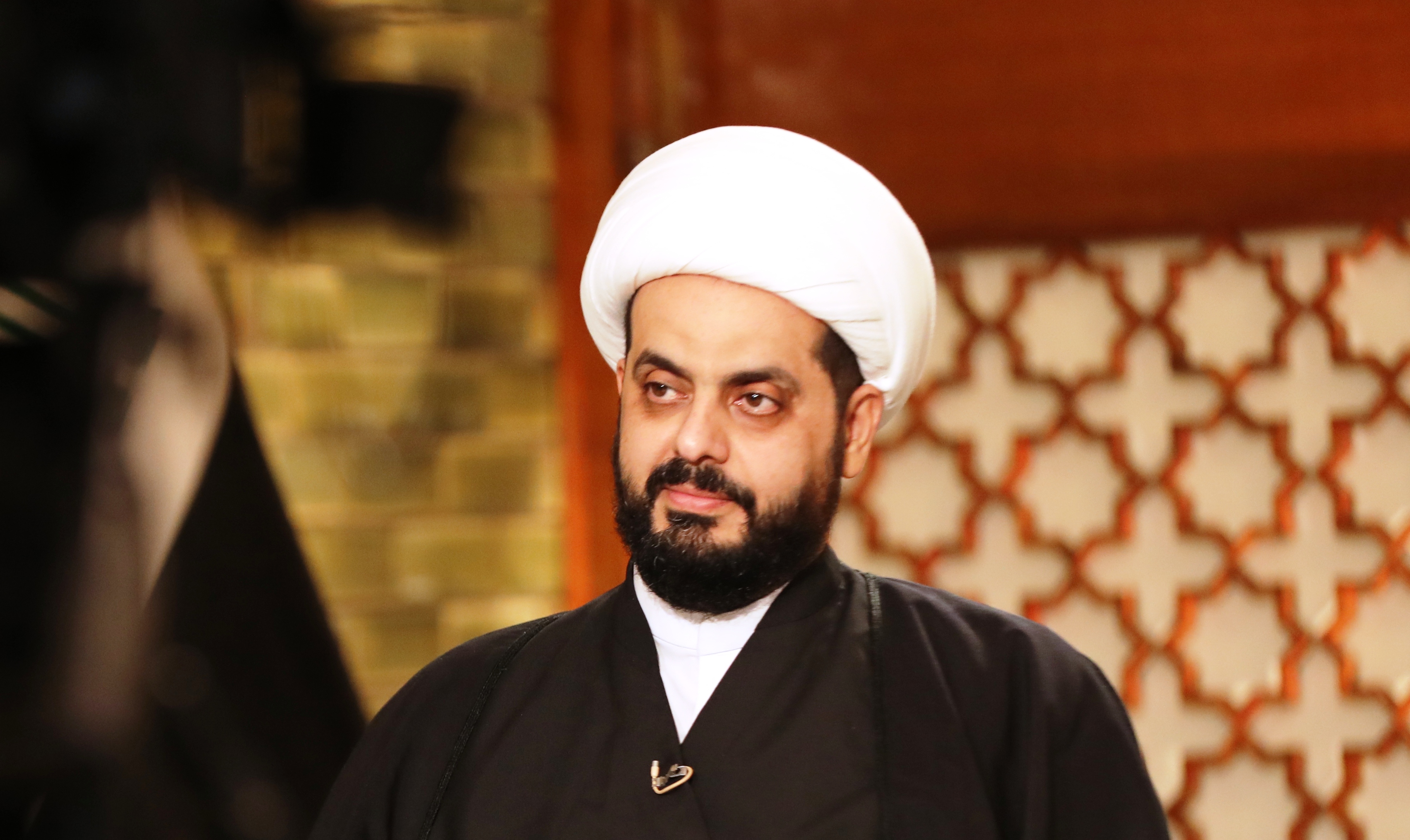
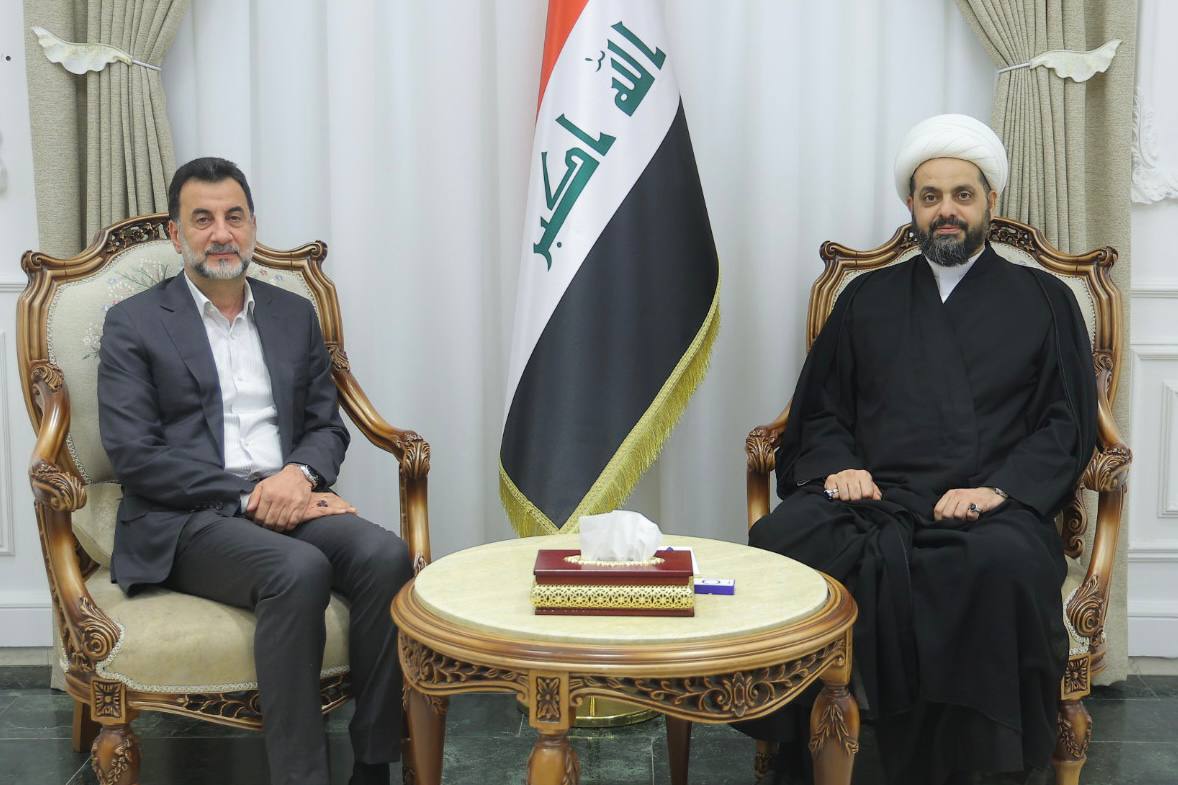
Sheikh Al-Khazali reviews key political and security issues in the country; bringing weapons under state control and finalizing government formation to top the agenda.

His Eminence Sheikh Qais al-Khazali, The General Secretary of the Asa'ib Ahl al-Haq, affirmed on Thursday that September 30 represents a pivotal and critical juncture for the stability and success of the Iraqi state. He noted that the developments and repercussions currently unfolding in the region stemming from the "Zionist" aggression against the Islamic Republic and the region at large will have fundamental and direct impacts on Iraq, more so than on any other country in the region.
In a televised interview, Sheikh Al-Khazali stated that September 30 holds special significance and great importance; it could prove to be a pivotal moment for the stability of the state and for overcoming the repercussions of the "Zionist" aggression against the Islamic Republic and the region as a whole. He also noted that the new government, formed under the leadership of Ali Al-Zaidi, faces major challenges at this stage.
His Eminence explained that the ongoing war in the region possesseson one hand ideological, doctrinal, and religious dimensions linked to what he described as the "End Times," while on the other it entails strategic dimensions aimed at redrawing the region's map. He noted that this redrawing is not limited to Iraq but extends to Saudi Arabia and Turkey, highlighting the magnitude of the danger and noting that regional states are aware of the war's objectives and the peril posed by the project to topple the Islamic Republic.
His Eminence added that Turkey, Egypt, Pakistan, and some Gulf states are aware that the realization of this goal would encompass all countries in the region, noting that the region's nations have in one way or another maintained a stance of support and backing for the Islamic Republic.
He noted that Iraq was at the forefront of nations supporting the Islamic Republic driven by geographical, historical, cultural, and social factors and emphasized that Iraq’s official stance, as well as that of the religious authority, clearly favors the Islamic Republic; meanwhile, Al-Sudani’s government paid a price for its supportive stance by failing to secure a second term.
Sheikh Al-Khazali noted that the Islamic Resistance factions adopted a proactive stance despite having reservations about certain actions while the Iraqi people demonstrated solidarity through their views, support, and donations to the Islamic Republic.
As for the second project according to His Eminence it is the American project, which has reopened the debate regarding the entire political experience and raised the prospect within the White House of designating Iraq as a state sponsor of terrorism; he emphasized that both the Gulf and American projects pose a threat to Iraq’s stability and unity.
His Eminence Sheikh Qais al-Khazali emphasized that restricting arms to state control is a crucial matter, noting that the aspiration of every Iraqi citizen and national political entity is state stability and the placement of weapons within state institutions; he further stressed the necessity of taking practical steps to achieve such stability.
He added that the ruling authority or the majority in Iraq is Shiite; consequently, Shiite political leaders have a greater stake than others in confining the possession of arms to state institutions. He noted that September 30 marks a critical and highly sensitive juncture, determining whether Iraqis will preserve their political experiment or head toward extremely dangerous pitfalls.
His Eminence emphasized that the Coordination Framework forces are unanimously convinced based on their own initiative of the necessity to advance the project of restricting arms to state control, deeming it a sound undertaking. He noted that this measure aligns with the spirit of the Constitution, has been advocated by the religious authority, and has featured in the government programs of multiple administrations, in addition to being proposed and adopted by Al'atar Altansiqei forces themselves.
His Eminence clarified that his stance regarding the restriction of arms is not contradictory; the movement’s position has been publicly stated since 2017—and reiterated in 2020, 2022, and 2025 explicitly affirming support for placing arms exclusively in the hands of the state, while simultaneously rejecting the surrender of those weapons.
He stated that there is a vast difference between restricting arms and surrendering them, emphasizing his rejection of surrendering weapons as was done by the Alawites in Syria and the Kurdistan Workers' Party (PKK) meaning handing them over to another state or an unstable one. He also rejected surrendering weapons for the purpose of burning or destroying them, adding that anyone who surrenders their weapon in such a manner "should prepare to shave off their beard or mustache".
Sheikh Al-Khazali also noted that the Resistance possesses domestically manufactured weaponry and fighters highly experienced in its use. He emphasized that the country's development requires integrating these fighters into the state apparatus rather than maintaining their affiliation with Asa'ib Ahl al-Haq asserting that this weaponry serves as the state's guarantor and protector. He further stressed that Iraq has reached a stage where arms should be under the control of state institutions, foremost among them the Popular Mobilization Forces.
His Eminence pointed to the experience of the Islamic Republic, which began amidst a revolution and subsequently entered a war; volunteer groups formed—bringing their own weapons to fight at the front and were later organized into what became known as the Revolutionary Guard.
He emphasized the need to address the reasons why certain factions refuse to hand over their weapons to the state, citing the presence of illegitimate foreign forces on Iraqi soil and the violation of its airspace noting that Iraqi airspace continues to be violated by the Israeli enemy and used to launch attacks against the Islamic Republic.
He explained that the proposal to consolidate arms control was accompanied by measures designed to reassure resistance factions about handing over their weapons to the state, noting that the project's success requires a government pledge regarding the withdrawal of US forces, the cessation of drone flights, and Iraq’s acquisition of air defense systems.
He added that the Zionist enemy and other nations, such as Turkey, are currently violating Iraqi airspace, emphasizing the existence of an intrinsic, domestic national motive rooted in the conviction to build the state, correct its course, and transform it from a faltering state into a strong one.
Sheikh Al-Khazali also deemed the process of consolidating arms under state control to be a natural one, noting that it requires a measured approach particularly in the context of candid dialogue. He pointed out that the September 30 deadline has lent greater urgency to the issue, and called upon the Shiite political establishment to engage in a genuine discussion regarding the question: How long will we need weapons that exist outside the state apparatus?
His Eminence Sheikh Al-Khazali noted that the Americans have an announced timeline agreed upon through negotiations with the Al-Sudani government to withdraw from Iraq and the Kurdistan Region, a process scheduled for completion on September 30.
He explained that the United States has initiated measures to pressure Iraq during the tenure of the Al-Sudani government, starting with the severing of security ties and the suspension of cash dollar shipments. He warned that if the U.S. reaches a point of despair regarding the failure to realign its relationship with Iraq according to its own vision, the ultimate decision would be to designate Iraq as a state sponsor of terrorism.
He revealed that, following the formation of Al-Zaidi’s government, the US Treasury informed the Central Bank of Iraq that it would withhold funds allocated to Popular Mobilization Forces (PMF) brigades linked to specific factions; he noted that the Prime Minister intervened regarding the US Treasury’s decision to block salaries for certain brigades within the PMF associated with these factions.
He emphasized that the initiative to restrict arms to state control is a homegrown national project endorsed by the Coordination Framework and advocated by the religious authority. He stressed that Shiite political leaders, as representatives of the majority, have a particular stake in this matter, affirming that the Coordination Framework serves as the political authority for the Shiite community, while the religious authority remains present at critical junctures.
He noted that the West and the United States in particular—continues to view Iraq with skepticism, regarding Al-Zaidi’s government as still being on probation. He explained that while the Prime Minister had requested a larger amount of cash, Iraq was provided with only $500 million a move he interpreted as a sign that the government is being tested.
He further indicated that a key reason for the resumption of cash flows to Iraq is the initiative to consolidate arms control under state authority, which serves as a strategic asset for Al-Zaidi’s government. He pointed out that, by contrast, during the formation of Al-Sudani’s government, the embassy was under rocket fire, and any prime minister hailing from the Coordination Framework was deemed unacceptable.
His Eminence Sheikh Al-Khazali maintained that the success of the initiative to consolidate arms under state control requires addressing the reasons why certain factions refuse to hand their weapons over to the government. He called upon the government to provide clear commitments regarding the withdrawal of US forces, the cessation of drone flights, and the acquisition of air defense systems.
He clarified that negotiations concerning the consolidation of arms were held with the Iraqi government—not the US side—emphasizing that this is a crucial point. He asserted that their response was unequivocal: the initiative is a national one that cannot be implemented according to American preferences, as their primary concern is the internal situation.
He stated that they emphasized there is no such thing as the "consolidation of arms" unless a government is formed and the Coordination Framework approves the measure. He noted that messages received last year via intermediaries had asked Asa'ib to hand over a "down payment"consisting of a portion of their strategic weaponryto the army in exchange for lifting the veto against them; he stressed that their response was firm, insisting that the consolidation of arms must be the result of a strictly national decision.
He pointed out that terms such as "organizing," "consolidating," or "transferring" arms do not alter the core issue namely, the existence of weapons outside state institutions that need to be brought under the management of official security forces. He added that while the term "consolidation of arms" is a sensitive one for some, the specific label does not matter; if changing the terminology is part of the solution, he advocates for flexibility in doing so.
He emphasized that the weapons belonging to Asa'ib have been consolidated specifically within the Popular Mobilization Forces (PMF) institution, and that the primary motivation behind this initiative is a commitment to the state's interests, as well as the government's success and stability.
Regarding the relationship between political forces and the armed forces, His Eminence Sheikh Al-Khazali affirmed that the Peshmerga are subject to and obey the orders of their political leadership in the Region, maintaining absolutely no link to the Commander-in-Chief of the Armed Forces. He emphasized that state sovereignty must be absolute rather than diminished, and that the Peshmerga ought to abide by the directives of the Commander-in-Chief.
His Eminence also called for addressing the Region’s leaders directly, noting that everyone is "in the same boat" and reiterating the necessity of full state sovereignty; he further announced his commitment to addressing the issue of decoupling the Region's political leadership from the Peshmerga forces.
His Eminence Sheikh Al-Khazali expressed general optimism, despite acknowledging the difficulties and challenges facing Iraq and the region. He noted that Iraq had previously overcome even graver challenges—such as the threat posed by ISIS and the US military occupation—and expressed hope that the challenge of September 30th would also be surmounted.
He explained that the country is on an upward trajectory of recovery, witnessing political, economic, and social improvements, albeit at a pace slower than what is achievable. He expressed confidence in the awareness of resistance faction leaders and their willingness to prioritize national and domestic interests over other issues. Furthermore, he anticipated that Iraq could enter a new political phase by 2029, characterized by greater understanding among the nation's various components, serving as a genuine foundation for realizing the interests of the Iraqi people.
Regarding the issue of disengagement and the Popular Mobilization Forces (PMF) Law, His Eminence Sheikh Al-Khazali affirmed that the separation between factions, movements, and political entities has not yet taken place due to various reasons. However, he emphasized a genuine and full readiness to separate the fighters from the political movement, asserting that this measure must apply to everyone. He noted that disengagement is a correct step that strengthens both the country and the PMF itself, while stressing that the enactment of the PMF Law is essential.
Addressing the stance on the head of the PMF Commission, Falih Al-Fayyad, and the management of the institution, Sheikh Al-Khazali affirmed that Al-Fayyad is a respected political figure. He clarified that their differences are methodological rather than personal, emphasizing his respect for Al-Fayyad as an individual, as well as for his tribal standing and political thinking.
He indicated that Al-Fayyad could assume various executive political roles, but that the military sphere—specifically the management of the PMF is not his domain. He pointed out that, since the formation of the Al-Sudani government, their position had been supportive of Al-Fayyad, assuming the role of Minister of Interior, viewing it as a stable and ready institution.
His Eminence explained that the criticisms regarding the management of the Popular Mobilization Forces (PMF) are fundamental in nature, noting that the force ought to remain insulated from political and electoral calculations. He pointed out that, since 2017, there has been a lack of genuine attention paid to the PMF institution regarding its organization, training, and operational readiness.
He noted that Al-Fayyad believes his presence within the PMF yields benefits and influence regarding elections and decision-making. He emphasized that this practice must cease, stating that exploiting the PMF for electoral purposes in inappropriate or improper ways is unacceptable, as the force is "too important, noble, and sacred" to be used for such ends.
He clarified that while the PMF legislation might allow for an extension of the retirement age by a year or two, Al-Fayyad is already over seventy. He stressed that their recent stance is unrelated to removing Al-Fayyad from the PMF's leadership; Asa'ib [Asa'ib Ahl al-Haq] neither possesses a replacement candidate nor covets the position itself. However, he affirmed support for the future leadership of the institution to be assumed by a figure from within the PMF organization itself, rather than from the constituent factions.
Regarding the incident in which Popular Mobilization Forces (PMF) headquarters were targeted, Sheikh Al-Khazali expressed his distress over the events. He noted that the Prime Minister had personally informed him during State Administration meetings about the aggression. He explained that the Prime Minister stated five times that he had received intelligence regarding the attack and had notified Al-Fayyad around 12:00 PM, whereas the PMF was notified only after the first strike had already occurred in Basra.
His Eminence emphasized that he was troubled by both the incident itself and the failure to provide timely notification. He stressed the importance of deferring to state institutions and called upon Al-Fayyad to address this matter, warning that failure to do so would cast a shadow over his record.
Regarding the completion of Al-Sudani’s cabinet, His Eminence Sheikh Al-Khazali rejected the notion that the obstacles and impasses were limited to the Al- Sadiqoon bloc and Dr. Laith Al-Khazali, asserting that such claims were incorrect and inaccurate.
He explained that there were multiple hurdles involved in the process, including issues concerning the State of Law Coalition and their nominee for the Ministry of Interior, as well as an impasse within the Sunni component—though the latter, regarding the Ministry of Culture, might be the least complicated issue—alongside the Deputy Prime Minister position allocated to the Al-Sadiqoon.
His Eminence noted that Dr. Laith Al-Khazali is the Al- Sadiqoon nominee for the position of Deputy Prime Minister. He acknowledged reservations held by the international community and the United States regarding the nomination but emphasized that no formal American rejection or veto has been received. He maintained that the matter is a domestic issue and a matter of entitlement, urging the Prime Minister to take the initiative.
He stated that the Asa'ib Ahl al-Haq is known for its history of national resistance and struggle, noting that Dr. Laith Al-Khazali is viewed with unease by the international community and the United States.
He added that there is a complication within the Kurdish bloc, as the post of Deputy Prime Minister is contested between the Patriotic Union of Kurdistan (PUK) and the Kurdistan Democratic Party (KDP). He also pointed to the Ministry of Migration as a hurdle in finalizing the government, noting a conflict involving Christian figures—some aligned with independent Christian leadership and others affiliated with the KDP—and mentioning internal opposition to Dr. Al-Khazali’s nomination for the Deputy Prime Minister role.
Finally, His Eminence affirmed that Al- Sadiqoon holds an electoral entitlement comprising the positions of First Deputy Speaker of Parliament, Minister of Labor, and Deputy Prime Minister. He asserted that they possess sufficient allies both within and outside the Coordination Framework to comfortably secure the approval of what they regard as their rightful share.
His Eminence Sheikh Al-Khazali revealed that the issue of the four Deputy Prime Ministers was approved during a Coordination Framework meeting held at Mohsen Al-Mandalawi’s office last March. He emphasized that the movement would not back down from the decisions made by the Coordination Framework and the State Administration Coalition, noting that no one could impose their own views upon them.
He pointed out that all factions within the Coordination Framework support proceeding with the appointment of Deputy Prime Ministers, apart from one individual; he explained that while Mohsen Al-Mandalawi was offered a ministerial portfolio, he declined it, seeking instead the position of Deputy Prime Minister.
He stressed that having deputies for the Prime Minister and the President of the Republic is essential given the numerous challenges and responsibilities involved and represents a genuine need to assist the Prime Minister in performing his duties. He also noted that a political decision had been reached regarding the appointment of one or more deputies for the President of the Republic.
His Eminence indicated that if a different proposal were to emerge within the Coordination Framework and garner unanimous agreement, it would be adhered to; however, such a move would require recalculating the government formation process.
Regarding relations with the Kurdistan Region, His Eminence Sheikh Al-Khazali revealed that he had received an invitation to visit Erbil from Kurdish leader Masoud Barzani an invitation reiterated by Nechirvan Barzani and Masrour Barzani confirming that the visit would take place after the government formation process is completed.
On the subjects of anti-corruption and the economy, His Eminence Sheikh Al-Khazali asserted that a state cannot be successful and strong if corruption exists at such a scale and nature. He noted that while no country in the world is entirely free of corruption as it exists to varying degrees and extents the key lies in acknowledging the issue when a corruption case is exposed.
His Eminence noted that every election cycle sees one or more major corruption scandals, calling for an end to such practices and for addressing the major corruption deals of the past.
He pointed out that Iraq had recently faced economic peril and was among the countries most affected by regional events, citing the Central Bank of Iraq Governor’s statement regarding the drop in dollar reserves from $120 billion to $65 billion.
He explained that Al-Zaidi had sought new solutions for oil exports measures that are already yielding successful results and highlighted Iraq's success in increasing oil production to around three million barrels, a move that signifies a shift away from economic collapse.
His Eminence emphasized his rejection of settlements that created a precedent where anyone tempted by corruption can commit it and then walk away scot-free. He also noted that the Central Bank’s strategic financial reserves had helped avert an even more difficult situation.
Sheikh Al-Khazali emphasized the importance of establishing safeguards and controls to prevent the recurrence of corruption, citing the adage: "He who is secure from punishment misbehaves." He affirmed the Prime Minister's sincere intentions to recover the funds, noting the empty state treasury.
He outlined two approaches to the anti-corruption file: the first involves remedial measures combined with mitigating steps for the return of funds, while the second entails the full application of justice. He stressed that everyone shares a responsibility to combat corruption and that genuine progress cannot be achieved without the concerted efforts of state institutions, foremost among them the legislative branch.
His Eminence noted that healing with a significant portion of the political forces within the "Coordination Framework"—supports the fight against corruption; they are partners who represent the will of Parliament. He pointed out that without parliamentary support, the initiative would stall, reiterating that all authorities and sincere political forces are committed to combating corruption.
Sheikh Al-Khazali emphasized the importance of establishing safeguards and controls to prevent the recurrence of corruption, citing the adage: "He who is secure from punishment misbehaves." He affirmed the Prime Minister's sincere intentions to recover the funds, noting the empty state treasury.
He outlined two approaches to the anti-corruption file: the first involves remedial measures combined with mitigating steps for the return of funds, while the second entails the full application of justice. He stressed that everyone shares a responsibility to combat corruption and that genuine progress cannot be achieved without the concerted efforts of state institutions, foremost among them the legislative branch.
His Eminence noted that healing with a significant portion of the political forces within Al'atar Altansiqei "supports the fight against corruption; they are partners who represent the will of Parliament. He pointed out that without parliamentary support, the initiative would stall, reiterating that all authorities and sincere political forces are committed to combating corruption.
Regarding relations with Gulf states and the broader Arab world, His Eminence Sheikh Al-Khazali noted that leaders of the Coordination Framework and successive governments had been keen to build bridges between Iraq and its Gulf and Arab neighbors. However, Gulf states did not reciprocate Iraq’s calls to strengthen ties citing the level of representation (heads of state and leaders) at the Arab League summit held in Iraq while expressing regret that some Gulf states continue to view Iraq through a sectarian lens.
He explained that the only Gulf leader to attend the Arab League summit was the Emir of Qatar and even he stayed for a very short time, owing to his good relationship with the then-Prime Minister. He emphasized that Iraq—through its government and the Coordination Framework forces—remains committed to fostering positive, cordial relations with the Gulf and taking the necessary steps to achieve this.
Sheikh Al-Khazali also warned against the sectarian rhetoric that has resurfaced recently, deeming it a threat to civil peace and calling for both a unified political stance and legal action against such discourse.
Turning to the issue of "Madinat al-Nasr" (City of Victory), he confirmed that the area formerly known as "Jurf al-Nasr" has been renamed "Madinat al-Nasr", a designation that is now legally recognized. He explained that their perspective acknowledges the complexities surrounding the file, including demographic and geographic factors, as well as the city's proximity to Karbala and Baghdad and its strategic position overlooking Babylon.
His Eminence noted that the file regarding Madinat al-Nasr is fraught with complexities; while some residents are innocent and entitled to a facilitated return, the fact that Asa'ib Ahl al-Haq fought in the Jurf that 90 percent of the terrorists there at the time were locals adds layers of complication to the issue.
He also emphasized the need for genuine solutions to prevent Madinat al-Nasr from once again becoming a source of security threats. He called for the matter to be addressed through political channels rather than media-driven narratives, affirming a readiness to exert effort toward resolving the situation.
In conclusion, Sheikh Al-Khazali reiterated his support for resolving the Madinat al-Nasr issue, stressing that the matter should not remain unresolved. He underscored that the principle of restricting arms to state control has been a publicly declared position since 2017, and that the primary objective behind these initiatives is the interest of the state, the success of the government, and the stability of Iraq.